Every successful organization has a clear sense of identity — who they are, what they believe, and where they're going. Your family deserves the same clarity.
A family vision and values statement isn't a corporate exercise. It's a compass. When you're facing a tough decision, navigating conflict, or wondering how to spend your limited time and money, your values guide you. When life feels chaotic, your vision reminds you what you're building toward.
Values vs. Vision: What's the Difference?
Values are your family's non-negotiables — the principles that guide daily behavior and decisions. They answer: "What do we stand for? How do we treat each other and the world?"
Vision is your family's north star — the future you're working toward. It answers: "Where are we headed? What kind of family do we want to become?"
Values are present-tense and constant. Vision is future-oriented and aspirational. You need both.
The Values Workshop
Set aside 60-90 minutes for this exercise. Include everyone old enough to participate meaningfully (usually 8+). Make it special — maybe over a nice meal or during a family retreat.
📝 Step 1: Brainstorm (20 min)
Each person writes down 5-10 words that describe what matters most to them. No filtering, no judgment. Common categories include:
- How we treat each other (respect, kindness, honesty)
- How we approach life (adventure, curiosity, hard work)
- What we prioritize (family time, health, learning, faith)
- How we engage with the world (generosity, service, sustainability)
Here are some values to spark your thinking:
📝 Step 2: Share & Cluster (20 min)
Go around and share your words. Write them all on a whiteboard or big paper. Look for themes — you'll notice clusters of related ideas. Group similar values together.
📝 Step 3: Prioritize (15 min)
Here's the hard part: narrow down to 3-5 core values. Not 10. Not 7. Three to five.
Why so few? Because if everything is a priority, nothing is. Your values should be memorable enough that everyone can recite them.
Give each person 3 votes. The values with the most votes become your finalists. Discuss until you reach consensus.
📝 Step 4: Define (15 min)
For each value, write 1-2 sentences explaining what it means for YOUR family. "Honesty" means different things to different families. Make it specific and actionable.
Example: The Johnson Family Values
- Adventure — We try new things, travel when we can, and say yes to experiences over stuff.
- Kindness — We treat everyone with respect, assume good intentions, and look for ways to help.
- Growth — We're always learning. Mistakes are lessons, not failures. We celebrate effort.
- Together — Family comes first. We show up for each other, even when it's inconvenient.
The Vision Workshop
Now that you know what you stand for, where are you going? Your vision should be inspiring but grounded — ambitious but achievable.
📝 Vision Exercise: The Future Letter
Imagine it's 10 years from now. Everything has gone well. Write a letter from your future family to your present family describing:
- What does a typical week look like?
- What have you accomplished together?
- What traditions have you built?
- How do family members relate to each other?
- What are you most proud of?
Read your letters aloud. Pull out the common themes. These form the basis of your vision statement.
Example Vision Statements
The Martinez Family: "We are a close-knit family that prioritizes experiences over things, supports each member's individual dreams, and leaves every place better than we found it."
The Chen Family: "We build a home filled with laughter, learning, and unconditional love — a launching pad for confident, kind humans who make a difference in the world."
The Williams Family: "We work hard, play hard, and take care of each other. Our home is the place everyone wants to be."
Making It Real
A vision and values statement that lives in a drawer is worthless. Here's how to make it part of daily life:
Display It
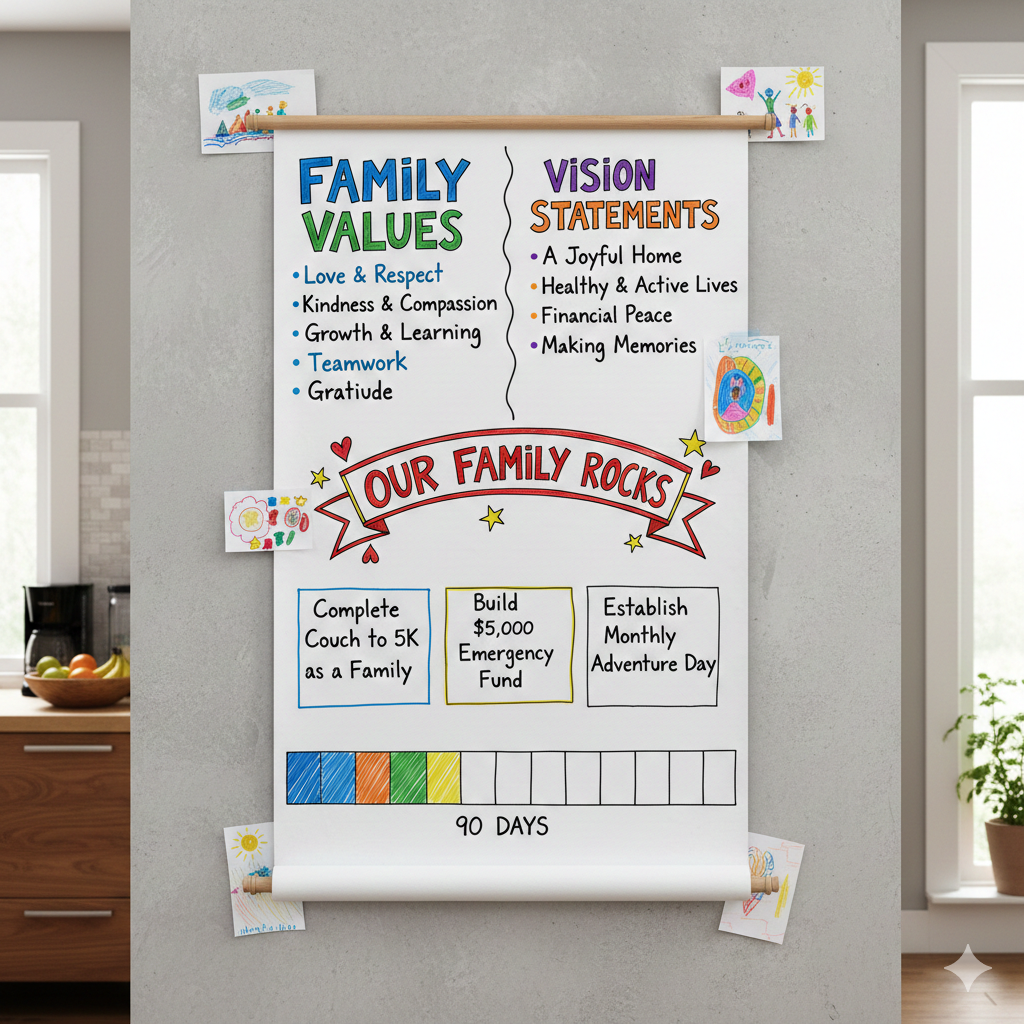
Put it somewhere visible. Frame it. Make it beautiful. Some families create artwork, others use a simple poster. The point is seeing it regularly.
Reference It
When making decisions, explicitly connect to your values. "We said adventure is a priority — should we save for the trip or buy new furniture?" When praising behavior, tie it back: "That was really kind — just like our family values say."
Review It
Revisit your vision and values annually. Are they still right? Has anything shifted? This is a living document, not a stone tablet.
Live It
The ultimate test: do your calendar and budget reflect your stated values? If you say family time matters but never protect it, something's off. Alignment between stated values and actual behavior is the goal.
For Families with Young Kids
Simplify the process. Use pictures instead of words. Focus on 3 values max. Make it into a fun craft project. Kids as young as 4 can participate in age-appropriate ways — and they'll remember values they helped create.
When Values Conflict
Sometimes your values will tension with each other. You value both adventure AND financial security. You value together time AND individual growth. That's normal and healthy.
The solution isn't to eliminate the tension but to navigate it consciously. When values conflict, have a conversation. Which value takes priority in this specific situation? There's no universal answer — but having named values makes the conversation possible.
"Our values aren't rules that constrain us. They're a compass that guides us. When we're lost, we look at the compass."
Start Today
You don't need to wait for the perfect moment. Start a conversation at dinner tonight: "What do you think our family stands for?" You might be surprised what emerges.
The families that thrive aren't the ones with the most money, the biggest house, or the most activities. They're the ones with the clearest sense of who they are and where they're going.
Your vision and values are the foundation. Everything else builds on top.